HOME
Presentation
Waterships, an ITMO Operator Compliant with Article 6.2 of COP21
Waterships positions itself as an international ITMO operator fully compliant with the legal framework established under Article 6.2 of the Paris Agreement (COP21). As a technical and institutional actor, the company implements bilateral cooperation mechanisms enabling the generation, verification, transfer, and corresponding adjustment of mitigation outcomes recognized by the Parties.
Article 6.2 allows States to cooperate voluntarily in order to exchange Internationally Transferred Mitigation Outcomes (ITMOs), provided that strict requirements for transparency, traceability, and environmental integrity are met. Waterships operates precisely within this framework: each ITMO produced originates from a project registered with the host country, validated by the competent national authorities, and integrated into monitoring reports in accordance with UNFCCC modalities.
As an operator, Waterships ensures:
the certified production of ITMOs through its sectoral programs (reforestation, soil restoration, agro‑ecological infrastructure, etc.);
full MRV documentation (Monitoring, Reporting, Verification) required by international guidelines;
the secure transmission of all data necessary for corresponding adjustments in national inventories;
diplomatic compliance with bilateral agreements concluded between the host country and acquiring Parties;
carbon integrity guarantees, including additionality, permanence, and the avoidance of double counting.
Through this architecture, Waterships enables partner States and companies subject to climate obligations to access ITMOs that are reliable, traceable, and legally enforceable. The company thus contributes to the operational implementation of Article 6.2 by providing a complete infrastructure for residual emissions neutralization and international climate cooperation.

1. Our Mission
Waterships develops and operates integrated solutions addressing:
water scarcity and hydric vulnerability
humanitarian needs in fragile environments
ecosystem degradation and soil instability
long‑term climate mitigation and resilience
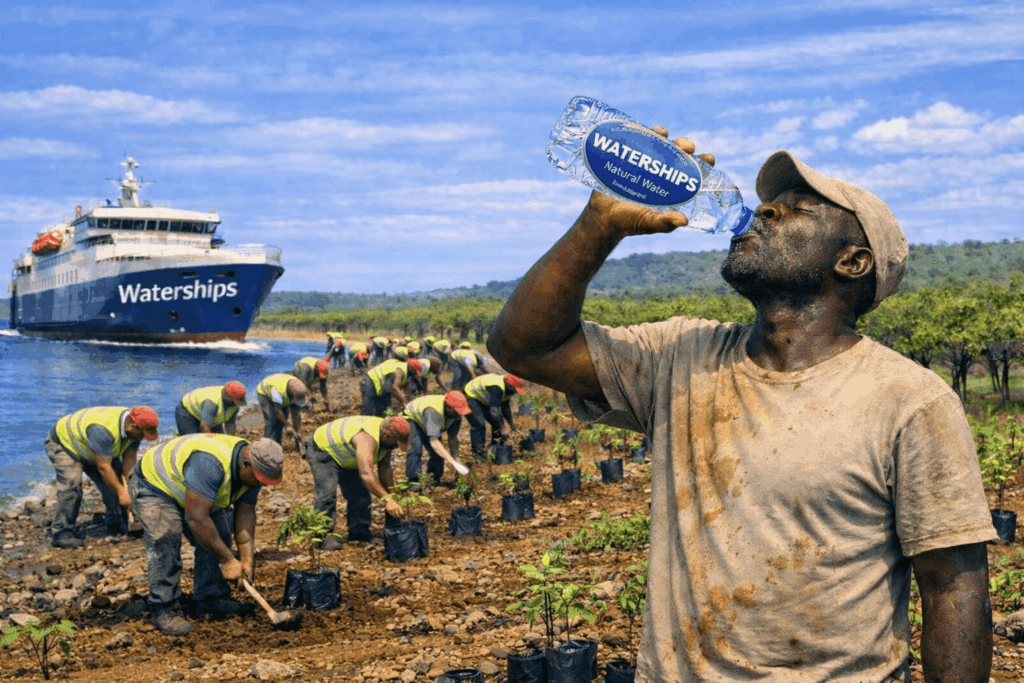
Our programs combine hydric technologies, regenerative reforestation, agroforestry, watershed restoration, and independent scientific governance through Waterships Climate & Forests (WCF).
2. Forward Carbon Credits Waterships
A premium climate asset with measurable humanitarian and ecological impact
The Forward Carbon Credits Waterships are purchase agreements for future certified carbon credits generated through:
regenerative reforestation and agroforestry
soil and watershed restoration
hydric and humanitarian programs reducing climate vulnerability
Each forward is backed by a portfolio of projects operated by national Waterships entities and scientifically supervised by WCF, ensuring:
MRV⁺ traceability (geospatial, hydric, agronomic, blockchain)
auditable datasets for international certification bodies
measurable humanitarian co‑benefits
full institutional compliance with global climate frameworks
These credits represent a new class of climate assets: scientifically robust, socially meaningful, and institutionally transparent.
3. MRV⁺ — Enhanced Measurement, Reporting & Verification
Waterships deploys an integrated MRV⁺ infrastructure combining:
high‑resolution geospatial monitoring
hydric and agronomic data streams
plantation and soil monitoring
digital traceability and blockchain anchoring
auditable datasets for certification
This system ensures transparency, reliability, and reproducibility of hydric, humanitarian, and climate impacts.
4. Water & Humanitarian Action
Waterships operates modular hydric solutions designed for both emergency and long‑term resilience:
potable water production units
SAP water‑gel for emergency response and agriculture
soil stabilization and watershed protection
support for vulnerable communities
These hydric interventions directly strengthen climate resilience and form a core component of the Waterships carbon programs.
5. Reforestation & Ecosystem Restoration
Our regenerative reforestation and agroforestry programs:
restore degraded soils
protect watersheds
enhance biodiversity
sequester carbon durably
support local livelihoods
They constitute the primary underlying asset of the Forward Carbon Credits Waterships.
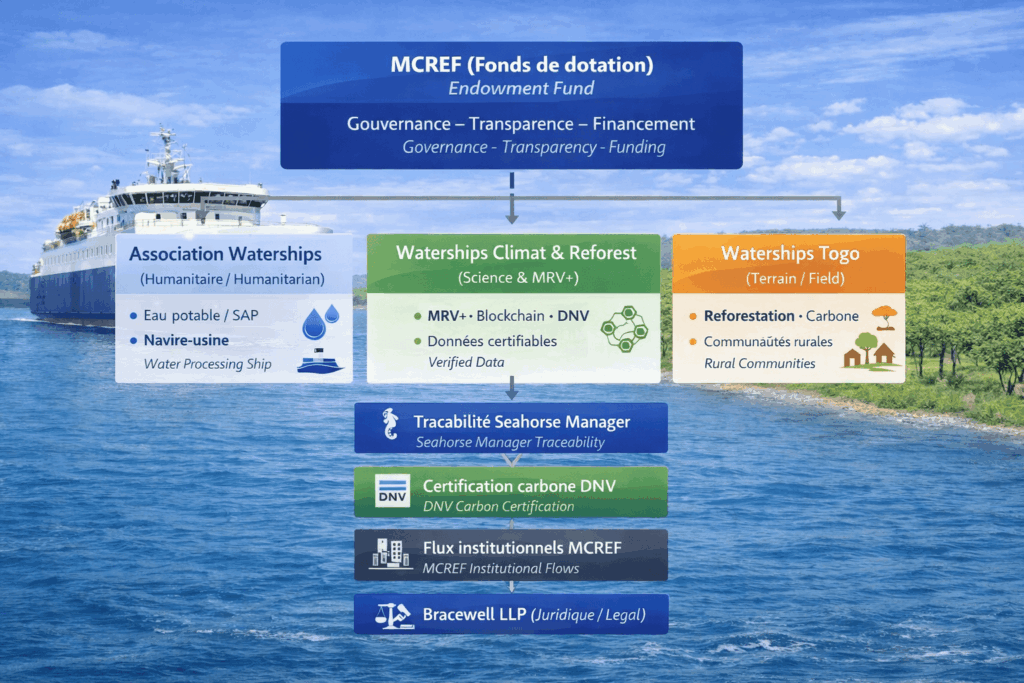
6. Governance & Institutional Architecture
Waterships operates through a robust institutional framework:
MCREF — Climate & Resilience Endowment Fund
WCF — Independent Climate & Forest Scientific Authority
Waterships France / Togo / Climate & Reforest — National operational entities
Partnerships with governments, public agencies, international organizations, and local communities
This governance ensures transparency, compliance, and long‑term program integrity.
7. Partners & Engagement
Waterships collaborates with:
governments and public institutions
international organizations
climate‑committed companies
climate finance institutions
local communities
Together, we build hydric and forest programs delivering measurable climate and humanitarian impact.